
Hiring in Healthcare | Using AI with Ethical Practices
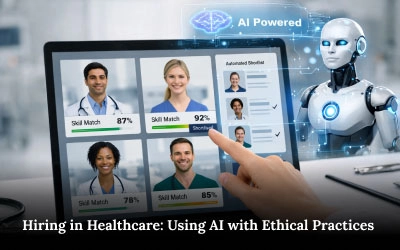
Discover Niyuk. Experience effortless screening and assessments. Book A Demo Artificial Intelligence is transforming the way – we hire in healthcare. Smart recruiting tools excel the process, support in finding the best professionals, and save valuable time for each one involved. As we adopt and rely on AI much widely, we must watch out and attain the concerns around transparency and ethics. Hiring in healthcare is the upcoming talk of the AI edge today. In this blog article, we are elaborating about ethics must be followed in AI-based hiring in the healthcare industry. Simplify hiring in healthcare with smart recruiting tools Try Niyuk to deliver results Book a Demo Challenges in Healthcare Recruitment Ethics As per AI healthcare data, while AI improves efficiency, it also comes with complex ethical risks that recruiters must browse carefully. 1. AI Bias in Recruitment AI algorithms trains from historical data, which mainly carries human biases. If earlier hiring practices is having some demographics, AI can improvise these types of biases. AI helps pick employees based on what happened in the past might like people from some backgrounds more than others. It might also say no to good people because of things that do not matter like if they are a man or a woman what country their family is, from or where they live. This may be unintentional, but careful picking of employee is a must. Unchecked bias in AI-driven hiring can establish imbalances and adjust on patient care quality in the long run. Collaboration with healthcare analytics consulting experts could help organizations in audit of algorithms, identify bias, and make sure for more equitable recruitment end results. 2. No Explainability and Transparency Giving candidates with clear explanations behind decisions improves transparency. But many AI hiring tools are “black boxes”, driven by tough algorithms, making it difficult for recruiters to explain decisions. Black boxes are AI systems assisting organizations in decision-making via deep learning. Anyhow, there are no clear explanations for those tough decisions they produce ever. To improve transparency, organizations might think for using AI model training services incorporating explainability features. Without transparency and explainability, organizations take risk for losing trust and could face legal challenges, if candidates claim the decisions to be not fair. 3. No Data Privacy and Consent AI tools need prospective amounts of personal and professional data about applicants. In the medical arena, where privacy is important, it is a ‘must’ to handle sensitive information responsibly. Recruiters have to collect candidate data with consent. You can ensure that it is stored safely and use it entirely for the intended hiring targets. Mishandling could discrete privacy laws and ethical standards. 4. Preventive in Accountability and Human Oversight Despite of how latest technology has become, AI must serve as a tool to support human decision-making in hiring. It must be full of ethical standards. And it is affirmative towards human intervention to check is it fair or not, breaching any law etc. Depending much on automation leads to a hiring experience lacking empathy and accountability, which are tough elements in the sector like healthcare. That’s why various organizations select to allies with healthcare-focused IT consultants, who help to make sure for accountability by designing governance frameworks, tracking AI performance, and setting up clear expansion of processes when automated decisions need manual review. Past Hiring Trends in Healthcare Before AI entry, hiring in healthcare replied heavily on human efforts, mostly taking for long hiring timelines and biases. The conventional hiring methods are having: Human Based Resume Screening: Recruiters had to filter via hundreds of resumes manually, looking for the correct skills, certifications, and experience. This process was slow and frequent, slowing down the hiring for required job positions. Subjective Assessments: Before AI, healthcare recruiters checked candidates with manual medication-calculation quizzes, paper skills tests, scenario-based panel interviews, and verbal reference checking. Limited Talent Pools: Employers mainly prefer their local job ads, professional contacts, and references. This gave them a little candidates pool, restricting their access to dynamic, quality candidates. Slow Hiring Timelines: Hiring for crucial medical roles would take months, sifting via endless no. of resumes, multiple interviews rounds, checking credentials, and slow communication. The lengthy process results in staff shortages. Human Compliance and Credentials: Even though a candidate accepted an offer, the HR team still need to incur days contacting state boards via phone or email to check for licenses and certifications. This is a slow, fragmented process which is prone to error and stretches for weeks, months. Hiring in Healthcare in the AI Age Artificial Intelligence has drastically improved healthcare recruitment, dropping down time-to-hire from various weeks to only some days. With the integration of AI in hiring, the landscape has changed remarkably, making processes more effective and easier. Automated Resume Screening: In some seconds, AI screening tools analyse resumes, filter candidates whose skills, credentials meet the role’s requirements while indicating non-matches. Data-Based Assessments: AI-driven platforms present virtual clinical conditions, and structured video interviews and medication calculation tests. Natural-language processing and behavioural analytics assess the candidate’s clinical judgment and teamwork verses evidence-based benchmarks. Such objective dashboards, powered by AI in healthcare, let recruiters judge applicants frequently and identify the talent mainly to boost up in patient care. Hyped Hiring Processes: Automatic scheduling, communication, and follow-ups support recruiters to move candidates fast via the hiring funnel. This prevents delay and non-availability of staff causing for the bad patient care. BoostedCompliance and Credential Verification:AI verification systems finely check licenses, certifications, and background details. This regulate the hiring process while making sure that rules are followed. Bias Reduction: Advanced AI tools synthesis on suitable skills and qualifications, not personal characteristics, reducing bias. Anyhow, regular updates and checks are always needed to ensure transparency. While no tool is perfect, well-trained AI tools help reduce unfair judgment. Overcome challenges in healthcare recruitment with AI Use practical AI in hiring made for actual need Start with Niyuk Third-Party Vendor’s Role in AI-Based Healthcare Solutions Outside vendors, adding AI technology providers, talent-acquisition SaaS companies, recruitment process outsourcing (RPO) firms, and data analytics experts, play a defining role in enabling AI adoption in healthcare recruitment. Their key responsibilities are: 1. AI Development and Integration Integrating customised AI development services automates data-heavy tasks like reading scans, highlighting high-risk patients, and organizing records, so clinicians get vital information fast. It also has treatment suggestions and real time outcome predictions helping doctors to make fast and accurate decisions and improve patient care. As AI excelling healthcare decisions, now accelerating cybersecurity by automation of threats, highlighting risks, and allowing fast reply. With the help of healthcare IT consulting services, the organizations can deploy these AI-driven tools into their current infrastructure. Health specialists use Electronic medical record (EMR software), Electronic health records, imaging machines, and telemedicine apps. This resolves the query- Why to develop a Telemedicine App. These tools may read scans, skim clinical notes, predict patient outcomes, and suggest possible diagnoses, all powered by latest neural-network models. Advanced systems made on a reinforcement learning environment allow continuous learning and optimization, enabling AI models to adapt based on real-world performance and feedback. 2. Data Collection Third-party vendors give tools for data collection, aggregation, and normalization. These can be incorporated into wearable devices, medical devices, attendant medicine software, and patient records. These tools help hospitals or clinics to gather and structure many data sources to use in AI analysis, while also allowing features like patient appointment text reminders to improve