
AI in Recruitment: Metrics that will matter in 2026
Discover Niyuk. Experience effortless screening and assessments. Book A Demo AI in recruitment is a current market trend for the corporate world. The recruitment arena is shifting from manual search to data-driven intelligence. Today, talent acquisition does not depend on the database size, but on smart filters of the top talent for every required position or role. As organizations face a “noise” crisis – thousands of AI-generated resumes are received for each job post – the role of AI in recruitment is evolving from a luxury to an essential element. At Niyuk, we really believe that the next edge of hiring belongs to those who can transform massive datasets into precise selections. By integrating a decent AI recruitment process, businesses can ultimately save several working hours lost to administrative friction in the current time. Automate your Hiring via AI recruitment Develop your elite teams with Niyuk Today Book Free Demo Now Beyond Automation: The Strategic Value of AI Recruitment Software Anyhow, modern AI recruitment software does more than just from a candidate from one position to the other. It analyses patterns. By 2026, we expect recruitment platforms based on Artificial Intelligence to function as intermediaries analysing candidates’ information or details provided but mapping their skills with the organisation’s outcomes and objectives. AI integration within a recruitment process allows your human recruiters to move ahead from their boring typing work. With platforms like Niyuk having features like Initial screening and resume matching, the team may concentrate on what really matters: improving customer relations and grabbing top-tier talent. The traditional/old hiring pipeline is mostly slow and prone to bias. A structured AI recruitment process forms a consistency level that manual screening simply cannot match. For instance, AI-driven metrics now allow us to track ” Hiring Quality ” with predictive accuracy, instead of waiting for six months to see if a new employee succeeds. Key changes in the process include: Skill-First Ranking: Moving beyond keywords to know the context of a candidate’s experience. Reducing “Slipped” Leads: Making sure that each applicant receives an instant, intelligent touchpoint of communication within minutes. Bias Mitigation: Using “masked” screening to make sure that each hire is based on merit, not subconscious preference. What strategic value Niyuk brings: Niyuk not only speeds up tasks; it simply refabricates the hiring journey to optimise human impact. Niyuk does it for precision and quality. Niyuk automates almost 70% of administrative routine tasks, shifting its focus from manual data entry to high-value tasks such as candidate interaction, customer requirement study, etc. Niyuk gives more important value to a candidate’s career journey and potential over keywords. With AI Assessments and AI interview features, Niyuk ensures quality hiring with fair competency. Why Top Firms are Investing in AI Recruitment Software? The conventional hiring landscape has reached a breaking point. For many years, talent acquisition teams have juggled under the weight of administrative debt, relying on fragmented Google Sheets and the labour work of scanning resumes line-by-line. This regular approach is not only slow; it is a major business risk. When a recruiter is stuck in a manual “paper trail,” top-tier talent accepts an offer elsewhere. That is even before the first interview is scheduled by the busy recruiter. Modern organizations are now moving away from these outdated systems and putting their resources into AI recruitment software. The shift isn’t just about replacing folders with files; it’s about moving toward a centralized, intelligent dashboard that offers total visibility. Unlike a spreadsheet, modern AI recruitment software understands the context of a candidate’s journey. It allows hiring managers to prevent guessing and start making decisions on real-time data, and the changeover of the recruitment desk from a reactive cost centre into a proactive growth engine. 1. Resolving the High-Volume Hiring Crisis This technological shift is most visible in industries like BPO, retail, and hospitality, where hiring is a dynamic game of scale and speed. In these sectors, a single job opening can attract thousands of applications, making what we call a “high-volume hiring crisis.” Trying to browse this manually is a mighty task – the process inevitably breaks, leading to “ghosted” candidates and exhausted HR teams. By use of AI recruitment software designed for bulk hiring, companies can automate the initial screening stages without any adjustment or compromise on quality. The software acts as an efficient filter. It rapidly finds candidates expertise in specific language, technical, or available criteria. For a BPO firm, this means the application time to the final shortlisting is dropped from weeks to hours. With the “noise” automation, recruiters can finally spend their time on the high-potential candidates. 2. How Niyuk Resolves the High-Volume Hiring Crisis? With technical screening and technical vetting automation, recruitment software lowers manual review time by around 70%. The HR team becomes free to handle or address high-potential candidates. This simplifies the AI recruitment process, removes candidate ghosting (fake candidates) and administrative issues, allowing BPOs to move their processes with speed a great hiring. Automate Vetting with Niyuk Tools Explore our premium AI recruitment software Request Niyuk Demo Redefining Efficiency via a Structured AI Recruitment Process Automation is often misunderstood as a direct replacement solution to the human element, but a well-made AI recruitment process protects it. When a recruitment pipeline is manual, the human recruiter is too exhausted by data entry to get engaged with people. By shifting to an intelligent workflow, AI essentially clears the path, allowing the “human” parts of hiring – empathy, culture fit, and negotiation. The modern AI recruitment process functions like a high-class filter. It begins the moment a candidate interacts with an advertisement, immediately triggering a series of background checks, skill validations, and logic tests. So, it is all about gathering deep insights before a recruiter connects with the phone. By the time a hiring manager sees a profile, the “process” has already verified that the candidate has the core competencies required for the role, effectively removing 70% of “mismatch” noise. One of the main pain points in regular hiring is the “subjectivity trap,” where candidates are mostly moved forward because of resume formatting or keyword stuffing over actual ability (even missing those required skills). A data-driven AI recruitment process replaces this guessing with objective benchmarks. Instead of a recruiter spending six hours a day in PDFs, the AI-based system uses semantic analysis to understand the depth of a candidate’s experience. It looks for patterns in career progression and cross-references them with the specific needs of the department. This level of accuracy guarantees that your final list goes beyond merely including candidates who present on paper. Instead, it features a carefully vetted selection of candidates who are statistically positioned to grow within your unique company culture. The outcome or result? A quicker hiring process and a notable increase in employee retention graph. Streamlining the Candidate Journey via the AI Recruitment Process AI Automation is often misunderstood to “remove” the human element, but a well-structured AI recruitment process protects it. When a recruitment pipeline is purely manual, the human recruiter is mostly too exhausted by data entry work to engage with people. By transferring to an intelligent workflow, we compulsorily clear the administrative path, enabling the “manual” parts of hiring – empathy, cultural fit, and negotiation – to take centre stage. The modern AI recruitment process works like a highly accurate funnel initiating the moment a candidate deals with a job post. It smoothly seals the gap between Sourcing and Screening, where the system gathers deep insights before a recruiter comes in. By the time a hiring manager sees a profile,
Navigating AI in Hiring: Legal and Ethical Considerations
Discover Niyuk. Experience effortless screening and assessments. Book A Demo The recruiting landscape has evolved. It’s becoming less common to use a highlighter to go through piles of resumes. We now have incredible tools that use artificial intelligence AI in hiring to find exceptional candidates more quickly than ever. I know it feels like a superpower, but power comes with responsibility. The speed and efficiency of AI hiring can excite us all but it’s easy to forget about the risks. legal minefields moral dilemmas and the very real risk of making our hiring procedure less rather than more human. This article serves as your manual. To help you use AI in hiring sensibly morally and without endangering your business well take you through the maze of contemporary hiring. Let’s discuss how these tools can be used to create a team that is not just faster but also better. A Day in the Life: How AI Has Changed the Hiring Game Think about your day. Where does AI hiring show up? It’s probably in more places than you think. Just have a look on some great findings about it here: 1. The First Filter AI is the intelligent helper that sorts through as many as 100 applications that arrive in your inbox. It saves you a great deal of time and allows you to concentrate on the best applicants by searching for the appropriate qualifications and experience. 2. The Friendly Chatbot That friendly little chat window on your careers page? That’s probably an AI chatbot. It’s there to answer basic questions and even schedule interviews, so candidates feel heard instantly, even after hours. 3. The Skills Scout Forget generic screening. AI can perform in-depth skill evaluations or watch video interviews for behaviours providing you with unbiased information that goes beyond a CV. 4. The Future Predictor You will be highly surprised to know the best fit for your expected job profile, even before knowing or meeting him in actual. That’s what predictive AI does, using data from your past successes to point you toward the candidates who are most likely to thrive in your company. This all sounds fantastic, and for the most part, it is. But here’s the thing: these tools are built by humans, and they are trained on our data. If our past decisions were biased, the AI will learn that bias. This is the central challenge that makes the legal and ethical side of AI in hiring so incredibly important. Outdated Hiring Methods are Holding you Back Embrace AI in hiring to simplify your process and find better candidates Contact Us The Legal Tightrope: Don’t Let AI Lead You to Trouble Let’s talk about the serious stuff. The law. You’re accountable for every hiring decision you make, even if an algorithm helped you make it. The old laws about discrimination weren’t written for AI, but regulators are now using them to hold companies responsible. Here’s what you must be watchful for: 1. Unfair Outcomes The most significant risk is algorithmic bias. Let’s say your AI hiring tool learns from past data from your business which may indicate that men were more frequently hired for a particular position. Subconsciously, the AI may then begin to deprioritize female applicants. Your business is at risk of legal action because even if you didn’t intend to you produced a discriminatory result. 2. The “Black Box” Problem In case you have used a tool without knowing how it went to its result. That’s the “black box.” Many AI hiring tools are so complex that even their creators can’t easily explain how they made a specific decision. This is a problem because if a candidate sues you for discrimination, you must be able to explain why you made a particular choice. New laws in city like New York are facilitating transparency as legal requirement. 3. Respecting Privacy A lot of your candidate’s personal information including their resumes test results and video clips is entrusted to you. It is legally needed of you to protect that data. Transparency about the collection, use with storage of data is compulsorily by international laws like the CCPA and GDPR. You must get clear consent and give people the right to control their information. The bottom line? AI in hiring doesn’t give you a free pass. You are responsible for the end results. Overlooking these legal aspects is a big mistake that could lead your company a great amount of money and its reputation. Your Team Needs a Fast, More Efficient Process Leverage AI in recruitment for tasks automation Book a Appointment The Ethical Essentials: Making a Human-First Hiring Process Beyond the legal stuff, there’s the ethical side of things. It’s about to do the right thing, even nobody is watching your action. Using AI in hiring, isn’t only about speed; it must be about making a fair, more human process. Here’s how you can ensure about the journey of your company is on the right side of history: 1. Humans are Still the Boss The AI should be your co-pilot. It should give you insights, flag good candidates, and handle the repetitive tasks. A human should always be in the loop to make the final decision. This “Human Loop” model is the most ethical way to work. 2. Constant Checks and Balances You can’t only “set it and forget it.” You must regularly audit your AI tool to ensure it’s not creating a bias over time. Think of it like a regular check-up for your technology. This regular monitoring is the only way to keep fair hiring process in your case. 3. Be True with Your Candidates The great way to develop trust is to be transparent. Tell your candidates when and how to use AI in hiring within your process. Explain what the tool is doing. For example, “We’re using AI to help screen the first round of applications to make our process more efficient.” Giving candidates an easy way to ask for a human review
The Ultimate Guide to Choosing an AI Recruitment Platform in 2025
Discover Niyuk. Experience effortless screening and assessments. Book A Demo AI is taking over every aspect of life and work. Recruitment with AI is no more a daydream. AI recruitment platform is the perfect solution for rapid and effective hiring for a business in 2025. An AI recruitment platform uses machine learning and predictive analytics to search ideal candidates, simplifying the initial hiring stages. Artificial intelligence (AI) is contributing a lion’s share to recruitment teams by offering the benefits like efficiency, personalization, and data-informed decision making. As per the Gartner report, 76% of businesses has assured that their organizations will go for AI technology within the next year to sustain in the market competition. In addition to improving the interaction between humans and technology, AI has changed the HR function in terms of luring, enlisting, and keeping talent. People in today’s workforce are beginning to understand AI’s potential, but talks about how to use AI-powered tech in hiring can differ even among experienced HR pros. The 2025 recruitment software guide highlights the increasing AI dominance and automation in hiring. It focusses the importance of data-driven decision-making, personalized candidate experiences, and strong integration capabilities. The guide will likely focus on solutions prioritizing ethical AI use, diversity and inclusion, and measurable improvements in hiring efficiency, quality. Through this guide, we’re working on the complexity from the equation, incorporating clarity to the AI role. AI gets involved in recruiting activities and giving straight information on AI’s favourable impact on HR, TA teams. This guide will help you: Utilize AI benefits and mitigate key recruiting challenges Best understand AI and its effects on talent recruitment Explore necessary AI-powered technology which will make life easier for candidates and recruiters Preview the future of what AI restores for recruiting What is AI for Recruiting? AI recruiting is the process of incorporating artificial intelligence (AI) to augment and automate manual, redundant tasks while offering individualization and data analytics throughout the hiring process. AI is the science of training machines to pretend human intelligence and make systems that can perform tasks normally done by a human brain. For instance, various industries have applied AI to process big size data to improve capability, accuracy level and productivity. In simple words, AI uses automation but extends intelligence – learning, reasoning, and adapting – to resolve tedious, redundant problems with quality results. AI recruitment means using artificial intelligence tech to make many parts of the hiring process better and more automatic. You can apply similar ways to make things automatic and get the same good results in hiring for tasks that happen over and over in big numbers like finding candidates checking them out, setting up meetings, and doing interviews. AI- technology is designed to speed up time-taking manual processes, so HR recruiters can emphasize on more valued human-tasks. AI is not here to replace human recruiters but to help them to optimise their results in less time and ultimately do remarkable cost savings. Recruiting AI allows talent acquisition teams to explore passive candidates and share data-driven insights guiding for data -driven decision-making and best results, like hiring quality. This helps Ai hiring assistants with AI recruiting tools to go for the right talent for the perfect role at the best suitable time. Are you ready to revolutionize your talent acquisition? Explore how AI recruitment platforms and recruitment SaaS solutions can transform your hiring strategy. Contact Us Importance of AI in Recruiting It is quite clear by today that, artificial intelligence in hiring processes improve efficiency via intelligence and automation of complex tasks making recruitment teams available up to focus more on strategic, big-picture goals. When you get AI right, it mixes into the background and is available for support. It’s equally important to refer that these tools must be considered as an AI recruiting assistant/advisor to recruiters. It assists workmen during the recruitment process. As recruiting AI is taking the leading role now and the market is going for more and more competitive in nature, Talent Acquisition leaders must consider integrating AI-powered recruiting software to get suit in an environment where fast working and smartness is a requisite. AI tools permit high-level personalization & data insights to produce better recruiting outcomes. AI as a Strategic Partner in Proactive Recruitment AI’s real spirit lies in its ability to makeover recruitment from a reactive process to a proactive one. With predictive analytics capabilities, AI can locate high-potential candidates also before they apply, supporting recruiters connect the high-class talent much early and more logically. Now, the life of recruiter has changed. They need not to wait for the right CV to come to them, in fact, they can easily locate the best fit candidate for their requirements and get connected with him via the data-driven insights. This reduces the hiring cost, valuable process time and delivering nice candidate experiences. 1. AI + Automation: Work Smarter, Not Harder Recruiters are consistently handling the pressure to act more. With AI-powered tools it is very much possible. AI release up recruitment teams to focus on strategic goals by automating their routine, time taking repetitive tasks. For example: Sourcing: AI-powered matching and scoring abilities identify the best-fit candidates with automation. Screening: Candidates are ranked because of a predefined criteria to simplify shortlisting. Scheduling: AI chatbots and calendar integrations handle interviews coordination efficiently. AI Automation is a game changer for recruiters, spending more than 30 hours per week on only sourcing activity. 2. AI + Personalization: Delivering Tailored Talent ExperienceS Outstanding talent experiences start with relevance. AI allows personalization throughout the complete talent lifecycle: Candidates get customized job recommendations and content on the basis of their profile, search behaviour, and preferences Employees benefit from AI-driven career path, alumni network connections, and internal shift opportunities Recruiters gain individual level talent pipelines with guided matches based on compatibility and historical success This type of personalization level elevates engagement, build loyalty, and supports talent promptly via the funnel. 3. AI + Data Insights: Better Information, Better Decisions Talent leaders are
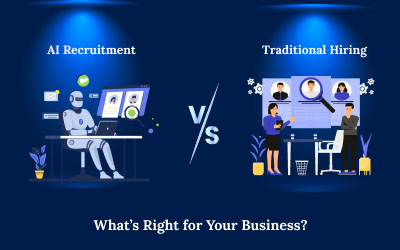
AI Recruitment vs Traditional Hiring: What’s Right for Your Business?
Discover Niyuk. Experience effortless screening and assessments. Book A Demo Every successful organisation’s backbone is a right recruitment. The recruitment process has been transforming a lot over some years, from conventional to now AI is taking over and playing a vital role in talent acquisition for businesses. As AI technology becoming more useful and spreading widely, Now, Hr recruiters and Hr managers have the choice to select between traditional recruitment process or AI-driven hiring process. Now we have, AI hiring software available with us. In this blog, we’ll dive deep into the differences between traditional(conventional) and AI recruitment, rolling out in detail, how AI is transforming the hiring process and helping mitigating challenges in talent acquisition. We will also highlight the prospective challenges AI brings, so you can make a data-driven decision about integrating these tools into your recruitment strategy. The Way Traditional Recruitment Process Works Manual vs Automated Hiring This is a pure manual recruitment process. It begins with job openings being advertised via many channels like job boards, social media, or word of mouth. After this, Recruiters can review resumes, shortlist candidates, and conduct interviews, all these steps are time-consuming and sometimes irregular. For recruitment agencies and HR department, this method relies mainly on human decision. While this enables for personal interactions and customised assessments, it also has its limitations in terms of speed, scalability, and objectivity. Challenges with Regular Recruitment Regular or traditional recruitment has been there for more period now as the go-to method, but it is having several pain points: Time-Saving: Manual screening more than thousands of resumes manually, conducting interviews, and performing admin tasks will make the recruitment process sluggish and non-effective. Subjectivity and Bias: Also, the most genuine recruiters may unintentionally allow unconscious bias to affect their hiring decisions. This will result in a lack of variety or unfair edge for some candidates. Limited Candidate Pool: Conventional methods mainly depend on job boards or individual networks, which normally limit the talent pool, specifically when looking for very niche or global candidates. Inconsistency: Each recruiter would assess resumes and conduct interviews separately, which leads to non-synchronisation in the recruitment process, making it complex to smart comparison of candidates. Redefining the Recruitment Journey in AI Way AI recruitment tools are completely changing over how talent is sourced, screened, and hired. By automating redundant tasks and enhancing decision-making processes, AI is resolving many issues that troubled in conventional methods. Niyuk is an AI-driven HR hiring platform designed to support recruiters make smart decisions in record time. Niyuk does the smart scanning of over 7 million profiles and match candidates to the right job based on their skills, experience, and personal choices. Here’s how Niyuk improves recruitment: Fast Candidate ShortlistingNiyuk helps you shortlist candidates in less than 24 seconds, saving your measurable time in the hiring process. AI Video InterviewsWith built-in AI video interview feature, Niyuk assures a simplified interview process which is rapid and more comfortable for both sides- recruiters as well as candidates. Multilingual CapabilitiesAvailable in more than 10 languages, Niyuk opens recruitment global level opportunities, assuring that talent can be resourced from anywhere, without any language barriers. Customizable Job DescriptionsNiyuk enables you to make individualised job descriptions, making sure about the right fit for every role.By using AI, Niyuk helps resolve the challenges those have conventionally slowed down the recruitment process, giving a fast, more efficient, and almost 0 biased approach to talent acquisition. Unlock efficiency with cutting-edge recruitment automation tools. See why AI hiring software comparison consistently points to AI’s advantages. Contact Us Challenges with AI in Recruitment Even though AI has many advantages, there are certain challenges to cope up with as follows: Over-Dependency on AlgorithmsOne of the risks of AI recruitment is that over-dependency on algorithms may lead to mechanical decision-making. While AI can identify patterns, it may ignore the human qualities that make candidates a suitable fir to the culture or may bring distinct strengths to a role. Human Factor in HiringAlso, AI tools can make hiring a lot simple, they just can’t put in the personal touch and the way relationships are built in traditional recruitment process.Some job aspirants would feel a bit put off by a process that feels too impersonal, or they might miss out on some valuable insights which only a recruiter can share during a real human conversation. Initial Cost to BearStarting with AI tools means investment in new technology and ensuring everyone knows the way to use it. For small companies or recruitment agencies, that initial cost can feel like a big block. Anyhow, when you look at the big picture, the long-term benefits – like closing roles faster and finding much better candidate matches – normally make that upfront investment worthy. Base of Good DataAI is only as smart as the data-based information it captures from. If the data it’s trained on is biased or incomplete, the AI tool might end up giving recommendations, that are either not correct or unfair. So, making sure that the data you feed into the AI is top-quality and diverse is required for really getting the best out of it in recruitment. Traditional Hiring vs AI Recruitment: A Comparison So, find below given quick comparison between traditional hiring and AI recruitment: Factor Traditional Hiring AI Recruitment Speed Slow, with manual steps and delays. Fast, screening automation and scheduling. Scalability Limits on how much a recruiter can handle. Scales easily, handles high volumes of candidates. Bias Can be influenced by unconscious biases. Reduces bias, works on data and skills. Personal Touch Develops strong relationships, entrust on fit. Less personal, but fast and more efficient. Cost Lower upfront cost, but labour more. Higher initial cost but saves time and money in long-term. Consistency Variable between recruiters, can be inconsistent. Regular, data-driven decisions. Efficiency Slow and admin-heavy, with high manual work. Simplified and automated, time saving. Both traditional or conventional recruitment and AI-powered recruitment have their doubtless existence in the hiring process. As AI delivers efficiency, speed,