
Hiring in Healthcare | Using AI with Ethical Practices
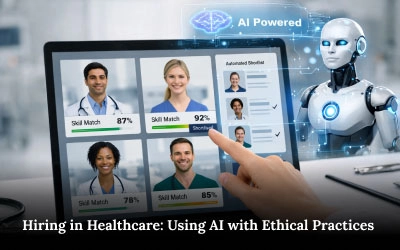
Discover Niyuk. Experience effortless screening and assessments. Book A Demo Artificial Intelligence is transforming the way – we hire in healthcare. Smart recruiting tools excel the process, support in finding the best professionals, and save valuable time for each one involved. As we adopt and rely on AI much widely, we must watch out and attain the concerns around transparency and ethics. Hiring in healthcare is the upcoming talk of the AI edge today. In this blog article, we are elaborating about ethics must be followed in AI-based hiring in the healthcare industry. Simplify hiring in healthcare with smart recruiting tools Try Niyuk to deliver results Book a Demo Challenges in Healthcare Recruitment Ethics As per AI healthcare data, while AI improves efficiency, it also comes with complex ethical risks that recruiters must browse carefully. 1. AI Bias in Recruitment AI algorithms trains from historical data, which mainly carries human biases. If earlier hiring practices is having some demographics, AI can improvise these types of biases. AI helps pick employees based on what happened in the past might like people from some backgrounds more than others. It might also say no to good people because of things that do not matter like if they are a man or a woman what country their family is, from or where they live. This may be unintentional, but careful picking of employee is a must. Unchecked bias in AI-driven hiring can establish imbalances and adjust on patient care quality in the long run. Collaboration with healthcare analytics consulting experts could help organizations in audit of algorithms, identify bias, and make sure for more equitable recruitment end results. 2. No Explainability and Transparency Giving candidates with clear explanations behind decisions improves transparency. But many AI hiring tools are “black boxes”, driven by tough algorithms, making it difficult for recruiters to explain decisions. Black boxes are AI systems assisting organizations in decision-making via deep learning. Anyhow, there are no clear explanations for those tough decisions they produce ever. To improve transparency, organizations might think for using AI model training services incorporating explainability features. Without transparency and explainability, organizations take risk for losing trust and could face legal challenges, if candidates claim the decisions to be not fair. 3. No Data Privacy and Consent AI tools need prospective amounts of personal and professional data about applicants. In the medical arena, where privacy is important, it is a ‘must’ to handle sensitive information responsibly. Recruiters have to collect candidate data with consent. You can ensure that it is stored safely and use it entirely for the intended hiring targets. Mishandling could discrete privacy laws and ethical standards. 4. Preventive in Accountability and Human Oversight Despite of how latest technology has become, AI must serve as a tool to support human decision-making in hiring. It must be full of ethical standards. And it is affirmative towards human intervention to check is it fair or not, breaching any law etc. Depending much on automation leads to a hiring experience lacking empathy and accountability, which are tough elements in the sector like healthcare. That’s why various organizations select to allies with healthcare-focused IT consultants, who help to make sure for accountability by designing governance frameworks, tracking AI performance, and setting up clear expansion of processes when automated decisions need manual review. Past Hiring Trends in Healthcare Before AI entry, hiring in healthcare replied heavily on human efforts, mostly taking for long hiring timelines and biases. The conventional hiring methods are having: Human Based Resume Screening: Recruiters had to filter via hundreds of resumes manually, looking for the correct skills, certifications, and experience. This process was slow and frequent, slowing down the hiring for required job positions. Subjective Assessments: Before AI, healthcare recruiters checked candidates with manual medication-calculation quizzes, paper skills tests, scenario-based panel interviews, and verbal reference checking. Limited Talent Pools: Employers mainly prefer their local job ads, professional contacts, and references. This gave them a little candidates pool, restricting their access to dynamic, quality candidates. Slow Hiring Timelines: Hiring for crucial medical roles would take months, sifting via endless no. of resumes, multiple interviews rounds, checking credentials, and slow communication. The lengthy process results in staff shortages. Human Compliance and Credentials: Even though a candidate accepted an offer, the HR team still need to incur days contacting state boards via phone or email to check for licenses and certifications. This is a slow, fragmented process which is prone to error and stretches for weeks, months. Hiring in Healthcare in the AI Age Artificial Intelligence has drastically improved healthcare recruitment, dropping down time-to-hire from various weeks to only some days. With the integration of AI in hiring, the landscape has changed remarkably, making processes more effective and easier. Automated Resume Screening: In some seconds, AI screening tools analyse resumes, filter candidates whose skills, credentials meet the role’s requirements while indicating non-matches. Data-Based Assessments: AI-driven platforms present virtual clinical conditions, and structured video interviews and medication calculation tests. Natural-language processing and behavioural analytics assess the candidate’s clinical judgment and teamwork verses evidence-based benchmarks. Such objective dashboards, powered by AI in healthcare, let recruiters judge applicants frequently and identify the talent mainly to boost up in patient care. Hyped Hiring Processes: Automatic scheduling, communication, and follow-ups support recruiters to move candidates fast via the hiring funnel. This prevents delay and non-availability of staff causing for the bad patient care. BoostedCompliance and Credential Verification:AI verification systems finely check licenses, certifications, and background details. This regulate the hiring process while making sure that rules are followed. Bias Reduction: Advanced AI tools synthesis on suitable skills and qualifications, not personal characteristics, reducing bias. Anyhow, regular updates and checks are always needed to ensure transparency. While no tool is perfect, well-trained AI tools help reduce unfair judgment. Overcome challenges in healthcare recruitment with AI Use practical AI in hiring made for actual need Start with Niyuk Third-Party Vendor’s Role in AI-Based Healthcare Solutions Outside vendors, adding AI technology providers, talent-acquisition SaaS companies, recruitment process outsourcing (RPO) firms, and data analytics experts, play a defining role in enabling AI adoption in healthcare recruitment. Their key responsibilities are: 1. AI Development and Integration Integrating customised AI development services automates data-heavy tasks like reading scans, highlighting high-risk patients, and organizing records, so clinicians get vital information fast. It also has treatment suggestions and real time outcome predictions helping doctors to make fast and accurate decisions and improve patient care. As AI excelling healthcare decisions, now accelerating cybersecurity by automation of threats, highlighting risks, and allowing fast reply. With the help of healthcare IT consulting services, the organizations can deploy these AI-driven tools into their current infrastructure. Health specialists use Electronic medical record (EMR software), Electronic health records, imaging machines, and telemedicine apps. This resolves the query- Why to develop a Telemedicine App. These tools may read scans, skim clinical notes, predict patient outcomes, and suggest possible diagnoses, all powered by latest neural-network models. Advanced systems made on a reinforcement learning environment allow continuous learning and optimization, enabling AI models to adapt based on real-world performance and feedback. 2. Data Collection Third-party vendors give tools for data collection, aggregation, and normalization. These can be incorporated into wearable devices, medical devices, attendant medicine software, and patient records. These tools help hospitals or clinics to gather and structure many data sources to use in AI analysis, while also allowing features like patient appointment text reminders to improve
How to Make Effective Pre-Employment AI Assessments (2026)
Discover Niyuk. Experience effortless screening and assessments. Book A Demo Recruitment has been less about resumes sorting and more about making quality decisions with speed and upgradation. In an environment, where talent is a key element, organizations may not afford fragmented workflows for recruiting or irregular assessments. The requirement for fast, accurate, and repetitive decision-making is pushing off HR teams to shift ahead of the conventional screening methods. AI assessments help in preparing early recruitment decisions fast, fair, and more regular. Moreover, relying on resumes or gut feelings, these tools evaluate candidates on real job-relative qualities, like how they resolve issues, communicate, adapt, or think under stress. They are designed to highlight potential, not just experience. As a business study found, while they don’t replace human judgment, they give your team better data to make more confident, informed choices. We have tried to break down how AI-based pre-employment assessments work, what they give to modern hiring strategies, and how to effectively deploy them in your organization, whether you’re growing a team or refining your assessment process in this blog article. Upgrade your hiring with smarter AI assessments Try Niyuk platform Go for Trial What Are AI-Powered Pre-Employment Assessments? AI-powered pre-employment assessments are well-designed Assessment methods by artificial intelligence to assess candidates. Assessment is done on job-relevant traits, skills, and competencies. These assessments support screen candidates and simulate real-world work scenarios to reveal how a candidate thinks, resolving problems, and applies their skills in context. Rather than relying only on past work experience, AI assess how well someone is likely to perform in the role they’re applying for. Mostly useful formats of AI-powered assessments are having: Video-based hiring assessments: Candidates answer to planned scenario-based questions visually, applying insights in their style, confidence level, and clarity. Technical tasks / simulations: These tasks test the functional, technical know-how in a job-specific context. Which is crucial for engineering roles, finance, or operations. For instance, to hire a Software Engineer position needing expertise in Python, the candidate may be prompted to solve Python test. Live situational assessments: Candidates interact with an AI agent to answer role-specific scenario questions and follow-up questions required to gauge decision-making, subject expertise, and practical thinking. Candidates do reply to statements / prompt revealing work preferences, personality traits, and compatibility within the team. When combined, these formats give you a comprehensive view of a candidate’s capabilities, much objective what you would get from a resume or a phone screen. How it Works? Candidates complete the assessment from anywhere at any time. The AI acts as an agent and analyses replies for communication skills, problem-solving ability, learning agility, and behavioural patterns, based on the criteria set for the role. Rather than having a recruiter present during the interview, AI agent acts as an intelligent assistant, automating repetitive initial screenings and resume shortlisting processes, while filtering top candidates based on their performance. It allows hiring teams to find high-potential candidates fast, especially in high-volume recruiting scenarios where manual assessments may not be that much useful. For example, instead of investing hours manually reviewing applications for a customer service position, recruiters may have candidates reply to a set of structured questions. The AI analyses reply for skills suitable to customer-service roles like tone, clarity, and communication skills. This latest solution can be developed with the help of an AI driven platform. A sales role can need confidence and adaptability, while a finance role may require analytical thinking and attention in detail. These traits are not easily grabbed with only resumes. Making AI-based assessments a precious tool for deep candidate profiling. Why to Use AI in Pre-Employment Assessments? AI-powered assessments boost initial-stage hiring with the analysis of how candidates reply to real-world scenarios. They are like timed video questions, problem-solving tasks, or behavioural prompts in AI led LMS. Inspite of resume scanning, these tools assess communication, adaptability, and critical thinking using structured, role-specific scoring. This allows organizations to hire at larger size without adjusting on candidate quality. 1. Fast Screening AI tools help assess 10 candidates in the time. It would take to assess 1-2 candidates using conventional over-the-call screening. This is a remarkable drop in the time spent on screenings at the start. This is very useful for roles with high application volumes, like customer service, sales, or graduate hiring programs. 2. Standardized Hiring With AI, each candidate is assessed with the use of the same parameters and scoring logic. This makes sure that each applicant applying for the same job; either it’s an entry-level role or a leader position, is assessed equally based on pre-specified job competencies. 3. Fair Hiring AI algorithms are programmed to emphasis on role-driven traits and remove factors that can introduce unconscious bias. For example, scoring model does not consider a candidate’s name, gender, or religious background, only their reply content. 4. Improved Candidate Experience AI algorithms are programmed to emphasis on role-driven traits and remove factors that can introduce unconscious bias. For example, scoring model does not consider a candidate’s name, gender, or religious background, only their reply content. 5. Scalability Either you are screening 50 or 5,000 candidates, AI tools does it easily. You don’t need to expand your recruiting team. Set up of assessments done once and enable the system to do the heavy load. Implementing AI Assessments into Initial Screening Based on the replies, the AI refines out low-scoring candidates and recommends top performers for next technical interviews, cutting down recruiter’s workload by 70%. You can take an AI development company’s help to make transparent and responsible AI hiring tools made to offer clear insights into decision-making processes, actively lower bias, and make sure for data privacy compliance. AI-driven assessments are very effective when incorporate on the verge of your hiring strategy. It serves as a planned, regular method to screen and filter candidates who are best suit to the job requirements. How to implement them intentionally is as per given below here: Step 1: Find Your Hiring Goals Inspite of AI’s evolving potential, various organizations stumble fast in their supply chain journeys due to certain persistent obstacles.The big issue is data quality and consistency. When formats are not matching, fields are missing, or data exist in isolated silos, also the smart AI can’t work efficiently. 1. Making Sure forData Quality & Unified SourcesBefore introducing AI into your screening process, get clear on what you’re solving for. It’s not only about use of AI. It’s about aligning AI with specific hiring goals. Do you want to reduce time-to-hire? Do you want to improve candidate quality? Is the goal to standardize hiring across departments? How to do it? Identify generic challenges in your early funnel. Connect with recruiters and hiring managers. Are they stressed out by resume volume? Struggling to evaluate soft skills objectively? Losing time to misaligned interviews. Write these pain points down. Example: “We get many resumes for customer-centric roles but can not assess quickly and assess communication skills.” Review 2 to 3 latest hires or failed interviews. What signals would’ve helped you spot the right (or wrong) candidates sooner? Think in terms of skills, behaviours, or traits which are currently hard to screen for at larger size. Translate those insights into measurable goals. Your goals may look like this: “Drop down time for reviewing resumes by 50%” “Filter candidates with strong critical thinking for technical roles.” “Get a regular view of soft skills before interviews.” This becomes your base for deciding how to use AI later. Step 2: Choose the Right AI Platform Once you have defined what you want to improve in your early screening stage, the next step is to select an AI platform which directly helps the goal. Aligning with AI Development services may help you make sure that the platform you select is customised to meet your hiring requirements. The right tool should simplify your shortlisting process and not compel you to change your full hiring flow. Here’s how to assess platforms: Start with your top screening goal from Step 1. For example: “We have a fast way to assess communication skills before interviews.” Use this goal as your decision filter when searching the tools. Shortlist platforms based on core features. Look for tools offering assessments designed specifically for early-stage screening. These
Trend of AI in Recruitment: The Future of Talent Acquisition
Discover Niyuk. Experience effortless screening and assessments. Book A Demo Just imagine many years back, the way HR people were doing a whole some resumes screening and sorting for a particular position, they need to fill up for the organisation. It was a gigantic act in true sense, to get the right one from thousands of applicants. Today, Trend of AI in recruitment has changed the entire game for the betterment. Artificial intelligence (AI) in recruitment is transforming the industry by simplifying processes and boosting decision-making. AI in recruiting automates tasks like resume screening and initial assessments, reliving HR professionals to focus on more strategic activities’ beneficiary for the organisations. It also declines time-to-hire by acquiring top talent more efficiently. In actual, 76% of HR leaders believe that, without deploying AI in hiring, in the next 12 to 24 months, they will be failing to gain the pace of the market. AI has a great potential to change hiring and HR as it evolves. Reform your Recruitment Process with AI Hire fast, smart with total precision Get Started Today Statistical Data about Companies Using AI in Recruiting Artificial intelligence (AI) in HR is useful across all industry verticals. Till 2024, almost 8% of companies have started applying an AI-first approach for their recruitment and hiring, which is automating the full initial recruitment process from application phase to interview scheduling phase. Apart from full automation, various organizations use AI to improve certain aspects of talent acquisition. Just have a look on some useful AI use cases and their current market usage: AI Use Case Percentage of Companies Description Sourcing and Engaging Talent 39-40% AI is used to find and interact with prospective candidates, building talent pipelines via employer-centric matching. Content Creation 27-28% AI is applied to make social media posts relative to recruitment, improving employer branding and outreach efforts. Data Analysis 27-28% AI is applied to analyse internal talent acquisition or recruitment data, to improve decision-making and strategy formulation. The combination of AI in hiring processes gives many benefits, adding increased efficiency, declined time-to-hire, and improved candidate experience. For an example to refer, Unilever’s decision to implement (use) AI in recruitment declined their hiring(recruitment) process timeframe from four months to only four weeks. It was a great saving around 50,000 labour (man)hours. Applying AI in recruitment is not a seamless journey. Queries for human biases, ethical work styles and the urge for transparency are frequent. Amazon removed their AI recruitment tool recently, due to its bias shown for female candidates. To address such issues, organizations are inspired to implement powerful AI assurance processes and maintain human oversight to handle biases and make sure for the fairness in hiring practices. Many professionals seek organised or designed ways to deepen their basic understanding of ethical AI and governance, with the use of learning platforms. As AI’s role in recruitment is increasing with variable degrees of implementation across stages of the hiring process, it is necessary for companies to balance technical efficiency with ethical guidelines to make sure for a fair, effective talent acquisition. Tips to Use AI in Recruiting Trend of AI in recruitment is ever rising. Here are some practical tips for deployment of AI in recruitment strategy: 1. Identify Your Needs Identify areas of the recruitment process which can be improved by AI. Consider time-to-hire, candidate -quality, and cost-effectivity. Highlight areas, where big improvement is needed. 2. Select the Right AI Tools Research and use AI tools to meet your organisation’s typical requirements. Find or identify tools for resume parsing, candidate sourcing and predictive analytics. Consider the costing, easy for use, and integration abilities. 3. Train your HR Team Guide your HR Division on how to use the AI tools. Make sure for the knowing the pros and cons of AI. Inspire experiments and continuous learning to get the best AI results. 4. Start Small and Upgrade Slowly or Stagewise Begin or initiate with AI in certain areas e.g. resume screening or candidate sourcing. Track the results, followed by the required adjustments. Slowly improve the use of artificial intelligence for recruitment. Benefits of Using AI in Recruitment AI provides many advantages to the recruitment process: 1. Hiring Efficiency Integration with AI automates time-taking resume screening and initial candidate filtering. AI in recruitment drops down the time to hire by accelerating the hiring process. A report by LinkedIn finds that AI has cut 50% of the time to hire and reduced resourcing costs to 70%. 2. Improved Candidate Experience AI can offer key insights, helping recruiters deliver more personalised and engaging candidate experiences. AI-powered customer support like can quickly and effectively reply to queries from candidates. As per a latest survey from Deloitte, it was found that 94% companies believe AI has a key use in HR. It enhances employee engagement, performance evaluations and hiring. It also removes candidate frustration and drop-offs with an easy and engaging application process. 3. Data Driven Decision Making AI recruiting tools use data analytics to identify top talent and predict the future performance. It offers useful information regarding hiring trends and workforce data analytics. Supports in making more valid decisions with fact-based data rather than gut feelings. 4. Reduced Hiring Bias It reduces unconscious human biases in the recruitment process. AI-based tools can screen applicants on skills and qualifications, and not any more on personal traits. It promotes diversification and right inclusion in the workplace. Challenges for Ethical Use of AI in Recruitment As AI is use is ever rising in recruitment arena, ethical use is also required. Some key challenges are: 1. Bias and Discrimination AI algorithms can preserve biases in historical data. This takes to discriminatory hiring practices. As per a study, AI resume screeners favour men over women if they are same with qualifications. AI companies are trying to fix this issue certainly after the Amazon issue. 2. Transparency and Explainability AI based decision-making may hamper trust and accountability in case of no transparency. It is important to get well versed with AI algorithms and the way they are getting conclusions. This will help search and remove biases. 3. Data Security and Privacy AI-based recruitment tools will gather and process sensitive personal data. This raises concerns for privacy and data misuse. There must be powerful data protection parameters to protect candidates’ information. 4. Job Displacement and Economic Impact Certain hiring tasks automation is likely to replace or move HR professionals. We must polish and upskill the workforce. The AI-based recruitment landscape is changing. Feel the Real Benefits of AI in Recruitment Find elite talent before your competitors See the AI Benefit with Niyuk Trend of AI in Recruitment Impacting on HR’s Decision Making AI is changing over the process of talent hiring. Let us discuss here about some major trends those are influencing in making decisions for HR. 1. AI-based Candidate Sourcing AI tools can efficiently scan large data of resumes and social media. They find prospective candidates. This saves the time and work of HR staff in sourcing the perfect talent, via multiple avenues. 2. Automated Screening and Shortlisting AI-powered algorithms can scan thousands of resumes and applications quickly with the use of pre-approved criteria. This saves time and offers an unbiased, objective assessment of the candidate. As per the study, 72% of organisations see AI as a key edge in HR. 3. Chatbots or Virtual Assistants AI chatbots can handle initial candidate interactions.
From Fraud to Authenticity: The Role of the AI Interviewer

Discover Niyuk. Experience effortless screening and assessments. Book A Demo Fake Candidates and Authenticity issues are the real uneven faced by Hr and recruitment people today. Businesses loose almost 30% of the cost of their first year’s income due to wrong hiring or bad hiring. This issue happens due to wrong information provided by candidates about their skills, experience or identity. This not only damages with extra expenses on hiring and recruitment, forcing for litigation also in many cases. This tarnishes your company image, as well. AI Interviewer is the real solution here. Fake candidates do proxy identifications or representations, deepfake and voice manipulations. Interviewer AI is the remedy over all these practices. In today’s AI era, many techniques have evolved, with which companies can cope up with these bottlenecks. Advanced AI- based fraud detection systems using voice biometrics and prompt behavioural analysis to strengthen hiring process. Want to Scale Interviews? Our AI Simplifies the Process Contact Us Existing Position of AI Recruitment Tools AI- driven recruitment systems have shorten hiring time by maximum 70%. Above all, 86% of recruiters are experiencing of improved efficiency with AI-driven solutions. AI recruitment tools improve 2 main functions. 70% of companies apply AI to write job descriptions and their marketing emails. Also, 70% of companies apply AI for scheduling interviews. NLP has really transformed these systems’ capabilities. Latest AI tools analyse unstructured data collected from various sources like phone calls, interviews, resumes, cover letters, and social media profiles and learn and adapt and enhance their replies on basis of various inputs of data to improve their outcomes other than regular automation. The future is prospective. As per sources, 67% of HR professionals experienced a positive impact of AI in hiring process. AI powered recruitment is the new upcoming trend today. With Ai, we can reduce the bias and focus on real things like skills and certifications rather than demographical data. These AI recruitment tools do everything. They reply to simple questions through chatbots to conduct real interview screenings. AI tools for hiring have many proven benefits. In the next section, let us see how AI technology detects fake candidates. Detection of Fake Candidates via AI The foundation of modern recruitment fraud detection is Machine learning algorithms. These efficient systems analyse patterns and predict threats faster and adapting to new deceptive tactics. The big issue arises with those candidates, who have used AI to generate their resumes. Nearly 42% of companies use AI tools to detect such fraudulent applicant’s source. These systems spot out common red flags like keyword stuffing, uneven formatting, and AI-generated content markers in resumes. AI detection systems work more sophisticatedly for interviews. They can easily identify mismatched voice-to-mouth movements and managed responses from out of-screen sources. This technology is certainly valuable when detecting deepfake attempts, where during interviews fraudster candidates manipulate their voice or appearance during virtual interviews. Machine learning has improved a lot in background verification task. AI systems check educational qualifications and employment histories at a time, on a larger scale. This makes the scrutiny (verification check) process faster and very useful in case of large-scale hiring camps. All these systems mainly depend upon predictive models built from earlier fraud cases to find out subtle deception signs. Even, they utilize modern tools to restrict automated mass applications, making sure that only quality candidates move ahead to the starting round. Ongoing background checks provide an additional layer of security. Latest Voice and Video Analysis: for Candidate Authenticity with AI Powered Hiring AI-powered voice and facial analysis tools are really transforming modern recruitment scenario. As per the latest research, 76% of companies are going to use AI for interview questions by 2025, and 63% companies are planning to get facial recognition data. Now, AI recruitment platforms analyse candidate interactions in various ways. They use data on voice patterns, intonation, and body language to check authenticity. Smart algorithms may detect small changes in eye movements, jaw movements and mouth positions that might reveal impersonation attempts. Voice analysis has developed now, beyond simple authentication. AI systems track speech patterns, tone variations, and natural pauses which could indicate fraud. 86% of candidates are in favour of attaining AI voice interviews over conventional video or chat-based assessments. Many platforms have empowered their verification processes by joining ID checks with social profile validations on sites like LinkedIn, GitHub, and GitLab. This 2-step process has remarkably declined candidate imitation risks. Key indicators these technologies check include: Speech patterns and voice consistency across multiple interactions Authentic replies versus AI-generated or scripted answers Natural eye movement and the screen engagement Apart from basic screening, such systems offer deeper insights into candidate authenticity by locating unnatural eye movements or voice patterns giving signal fraud. The industry is regularly evolving its approach with latest analysis tools which create a more secure, efficient hiring process. Companies may verify candidates now with more confidence making sure for a positive experience. AI Screener leverages advanced technologies like computer vision to offer trustworthy remote proctoring features, making sure for a smooth, secure interview experience. Key features are: AI-powered Recruitment: The platform uses AI resumes screening, conduct automated video interviews and analyse candidate performance. Mass Recruitment: It is designed to smartly screen, interview, and shortlist many candidates. Avoid Bias in Hiring: The tools aim to drop down human bias by offering structured evaluations and data-driven reports. Tailored Assessments: It offers over 100 pre-built assessments for various job roles and allows for customization. Time & Cost Savings: By automating early-stage interviews and candidate screening, it saves significant time and resources of companies, using it. Niyuk.AI’s platform is available online and aims to simplify the hiring process for businesses of all sizes, from startups to large enterprises. Benefits of Using AI Interviewers for Authentic Hiring Using AI to detect fake candidates presents several important benefits: Enhanced Reliability and Accuracy: AI lowers manual error, offering correct insights across candidate’s skill and candidate authenticity. Time and Cost Efficiency: AI screening primarily drops resource costs, permitting the recruiters to
Navigating AI in Hiring: Legal and Ethical Considerations
Discover Niyuk. Experience effortless screening and assessments. Book A Demo The recruiting landscape has evolved. It’s becoming less common to use a highlighter to go through piles of resumes. We now have incredible tools that use artificial intelligence AI in hiring to find exceptional candidates more quickly than ever. I know it feels like a superpower, but power comes with responsibility. The speed and efficiency of AI hiring can excite us all but it’s easy to forget about the risks. legal minefields moral dilemmas and the very real risk of making our hiring procedure less rather than more human. This article serves as your manual. To help you use AI in hiring sensibly morally and without endangering your business well take you through the maze of contemporary hiring. Let’s discuss how these tools can be used to create a team that is not just faster but also better. A Day in the Life: How AI Has Changed the Hiring Game Think about your day. Where does AI hiring show up? It’s probably in more places than you think. Just have a look on some great findings about it here: 1. The First Filter AI is the intelligent helper that sorts through as many as 100 applications that arrive in your inbox. It saves you a great deal of time and allows you to concentrate on the best applicants by searching for the appropriate qualifications and experience. 2. The Friendly Chatbot That friendly little chat window on your careers page? That’s probably an AI chatbot. It’s there to answer basic questions and even schedule interviews, so candidates feel heard instantly, even after hours. 3. The Skills Scout Forget generic screening. AI can perform in-depth skill evaluations or watch video interviews for behaviours providing you with unbiased information that goes beyond a CV. 4. The Future Predictor You will be highly surprised to know the best fit for your expected job profile, even before knowing or meeting him in actual. That’s what predictive AI does, using data from your past successes to point you toward the candidates who are most likely to thrive in your company. This all sounds fantastic, and for the most part, it is. But here’s the thing: these tools are built by humans, and they are trained on our data. If our past decisions were biased, the AI will learn that bias. This is the central challenge that makes the legal and ethical side of AI in hiring so incredibly important. Outdated Hiring Methods are Holding you Back Embrace AI in hiring to simplify your process and find better candidates Contact Us The Legal Tightrope: Don’t Let AI Lead You to Trouble Let’s talk about the serious stuff. The law. You’re accountable for every hiring decision you make, even if an algorithm helped you make it. The old laws about discrimination weren’t written for AI, but regulators are now using them to hold companies responsible. Here’s what you must be watchful for: 1. Unfair Outcomes The most significant risk is algorithmic bias. Let’s say your AI hiring tool learns from past data from your business which may indicate that men were more frequently hired for a particular position. Subconsciously, the AI may then begin to deprioritize female applicants. Your business is at risk of legal action because even if you didn’t intend to you produced a discriminatory result. 2. The “Black Box” Problem In case you have used a tool without knowing how it went to its result. That’s the “black box.” Many AI hiring tools are so complex that even their creators can’t easily explain how they made a specific decision. This is a problem because if a candidate sues you for discrimination, you must be able to explain why you made a particular choice. New laws in city like New York are facilitating transparency as legal requirement. 3. Respecting Privacy A lot of your candidate’s personal information including their resumes test results and video clips is entrusted to you. It is legally needed of you to protect that data. Transparency about the collection, use with storage of data is compulsorily by international laws like the CCPA and GDPR. You must get clear consent and give people the right to control their information. The bottom line? AI in hiring doesn’t give you a free pass. You are responsible for the end results. Overlooking these legal aspects is a big mistake that could lead your company a great amount of money and its reputation. Your Team Needs a Fast, More Efficient Process Leverage AI in recruitment for tasks automation Book a Appointment The Ethical Essentials: Making a Human-First Hiring Process Beyond the legal stuff, there’s the ethical side of things. It’s about to do the right thing, even nobody is watching your action. Using AI in hiring, isn’t only about speed; it must be about making a fair, more human process. Here’s how you can ensure about the journey of your company is on the right side of history: 1. Humans are Still the Boss The AI should be your co-pilot. It should give you insights, flag good candidates, and handle the repetitive tasks. A human should always be in the loop to make the final decision. This “Human Loop” model is the most ethical way to work. 2. Constant Checks and Balances You can’t only “set it and forget it.” You must regularly audit your AI tool to ensure it’s not creating a bias over time. Think of it like a regular check-up for your technology. This regular monitoring is the only way to keep fair hiring process in your case. 3. Be True with Your Candidates The great way to develop trust is to be transparent. Tell your candidates when and how to use AI in hiring within your process. Explain what the tool is doing. For example, “We’re using AI to help screen the first round of applications to make our process more efficient.” Giving candidates an easy way to ask for a human review