
How to Stop Cheating in Skills Assessment with Fair AI
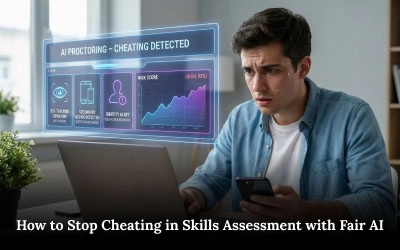
Discover Niyuk. Experience effortless screening and assessments. Book A Demo AI in HR has allotted many traits which are helpful to today’s HR people across all sectors going for hiring. Skills assessments with AI are one of them and it’s most important in the automated HR process for hiring and recruitment now. Many recruiters prefer to conduct online skills assessments for candidates to save the time. But this also attracts dishonest behaviour of the candidate on his side. A false picture is offered to the recruiter by the candidate during this assessment activity, which he may not worthy of. ‘Honesty has become a personal virtue.’ So, to maintain the fairness in AI hiring, an effective method of conducting these skills Assessments is a must. This will help in the right hiring in the long run with trustworthy resourcing. In this blog article, we are going to discuss the precise methods which will deliver fairness in AI hiring by conducting faired assessment practices. At first, we will briefly elaborate about fairness in AI hiring. Experience the Ace of Smart AI Hiring Find your next top performer today! Transform Your Talent Acquisition What is Fairness in AI Hiring? Assessment of candidates solely by their skills, performance and abilities is called fairness in AI hiring. It makes sure for the protection of personal information, demographics, background, or other biases don’t affect the candidate assessment. Sustaining of a fair skills assessment process asks for transparency and equality during the actual testing. This shows that hiring mechanism will strictly work for all candidates for checking their standard and described criteria’s- if they are matching or not. Every candidate needs to have the same platform. There is not a single chance for any candidate to do any malfunctioning or dishonesty during the skill assessment in remote. In fact, all candidates are given same conditions with same challenge to test the best one across them. Any breach of trust by anyone of them, shows error in the mechanism. As a result, this will lead to the wrong hiring on false views or results shown. Ways of Cheating in Online Assessments There are 5 ways of cheating normally carried out by candidates during their online skills assessments. According to them, recruiters can put on the security checks to get fairness results. Find them as follows: 1. Copying Answers from Internet and AI Tool Almost 22% of candidates giving online assessments have committed that they have cheated by using internet. Some of them used, almost 37% ChatGPT and remaining 71% used Google search results. Search queries are the easiest way for them to cheat or rather copy the questions and get the answers from ChatGPT. This brings great results in less time. One can use the second device to do so. Such answers seem too much right or technically perfect as an Identical answer to given question. The scenario becomes denser, when all candidates deliver the same answer, where an individual thoughtfulness is required while answering. 2. Collective Preparations Candidates contact others with questions and get shared answers or find answers from earlier made answer banks. Candidates share questions upon giving test to their groups, communities or drives. These becomes standard sets of questions after certain time. This impacts on future tests whenever these questions come across, the candidates can perform far better than their earlier performance. This is also one kind of cheating for online skills assessments. 3. Multiple Attempts with Different Accounts Candidates try to attain the test with multiple accounts for multiple times. For the first attempt they copy or try to get these questions. After that, they get answers for these questions. After getting answers ready or well-studied, they try to attain the same test with different user account and try to outperform the test to make a successful performance. This breaches the fairness in hiring. This also leads to bad hires due to cheated performance holders getting the opportunity only because of wrongly achieved performances during hiring process. 4. False Expectations Matching In this method, Candidates studies thoroughly the job descriptions about those job profiles they want to get placed. They also study the old, selected candidates’ data, information and other required details about the same. Then they manage the answers which recruiters normally pick or recommend as expected one. Any preparation in the right direction may not be called as wrong practice, still it becomes artificial all the times due to candidates’ style of responses. Normally, such performances fail to show the required calibre or problem-solving. Even though they are delivering the perfect answers matching to the company’s expectations, they are not the right choice to hire for regular challenges and situations to handle for the prescribed JD. 5. Dummy Practices This is an important and direct fraud method in today’s age of AI based skills assessments. A candidate can hire a person, close friend or any talented third party to appear for the test with his name or identity. This person normally cracks the ai assessment criteria. But they refuse to show their identity visually. This is really a bad professional practise leading for the cheating and doing injustice to the fairness hiring approach and strategies of any organisation. End Effects of Cheating on Hiring Results More than 60% of hiring managers have confirmed that many candidates are using Gen AI to give online assessments. This kind of cheating directly affects the quality of hiring. Below are the 3 effects recruiters see due to cheating by candidates during assessments online, leading to bad hiring, affecting fair hiring. 1. Inaccurate Results This is direct result of hiring a bad resource who is not having accurate skill sets described in the JD. The candidate has hired wrong practices to pass the assessment online, not showing his real capabilities and even do not getting the information about whether he can handle the desired job or not. Wrong hires lead to hiring errors. This also gives early exits as well as declining the team performance. The wrong hires also build up recruitment costing due to frequent or uneven turnovers. These all are long term bad effects. 2. Breach of Trust and Candidate Experience As cheating becomes the regular exercise, the candidate gets lost in mid of the process or so as well as recruiters also start losing interest. They feel like losing confidence on their data reliability leading to more chances for hiring with compromises on candidate qualities and skills. Candidates feel stressed due to competition with wrong practices doing candidates. This more takes up to tarnish the employer brand image as well as loose of faith on transparency and merit acclamation or appreciation.
Niyuk: The Best Hiring Tool to Cut Recruitment Cost
Discover Niyuk. Experience effortless screening and assessments. Book A Demo In today’s dynamic talent market, recruitment plays a significant role in driving the growth and success of modern organisations. Anyhow, the hiring tool can have a remarkable impact on a company’s operations and entire human resources budget as well. From advertising of job openings to onboarding new hires, these costs can rapidly add up, certainly when recruitment processes are not to the mark. We have the solution i.e. Niyuk for the same. In today’s era of smart recruitment software, businesses have the tools to simplify the hiring process, boost decision-making, and dramatically decline recruitment costs. With the use of AI-based screening, automated communication, and centralised applicant tracking, businesses can lower manual effort, boost accuracy, and really cut down non-required expenses. This innovative approach makes sure for companies not only to save money but also improve the entire recruitment experience. What Does Recruitment Cost Means? Recruitment cost is the total cost required for attracting, selecting, and hiring candidates during the full recruitment or hiring process. This covers a wide range of activities and resources contributing to the hiring process, whether they are internal / external to the organisation. Recruitment costs are generally categorised into 2 types: 1. Direct Costs These are the visible, immediate expenses directly relative to a role closure. They cover up job board fees, recruitment agency charges, advertising costs for jobs, background checking cost, travel reimbursements for candidates, and employee referral bonuses. They are typically easy to track and quantify. 2. Indirect Costs These are the less obvious but equally remarkable costs arising from the recruitment process. Indirect costs encompass lost or missed productivity because of the vacant positions, training activities, onboarding of new employees, time shared by internal HR staff on resume screening and candidate interviews and increased expenses due to a bad (or poor or non-deserving) hire. Effective workforce planning and budget control are dependent on monitoring and reducing these types of hiring expenditures. Realizing the average recruitment cost per hire enables organisations to set benchmark and strategize cost-effective recruitment working. Affordable AI-Driven Recruitment Implement our AI recruitment software to optimize your AI recruitment process. Book Demo Today What Is the Importance of Recruitment Cost? Recruitment is not only about recruiting candidates for the open vacancies. It’s a strategic function which may drastically affect your organisation’s budget and performance, as well. Knowing about the critical importance of recruitment cost supports you to take up best possible hiring decisions, smart resource management, and guide long-term business growth. Here’s why it’s vital: 1. Impact on the Overall HR Budget Recruitment may represent a large portion of an organisation’s HR cost. Advertising job roles, using paid services of recruitment agencies, running background checks, and onboarding all come at a cost. When hiring is not sufficient or happening again due to poor retention, these costs grow at high rate, leaving less budget for other key HR initiatives like employee engagement, training, and development programmes. 2. Influence on Time-to-Hire and Quality-of-Hire Recruitment cost directly effects on how fast you get in the fresh talent. The more time it requires the more hiring cost. This also increase burden on teams as well as more time wastage for the same. On the other hand, accelerating the process to cut costs can damage the quality of the hire, this leads to mismatched candidates and eventual turnover. A balanced hiring strategy is a key to cost control without doing compromise on the quality of talent. 3. Hidden Costs of Poor Hiring Decisions Not all recruitment expenses are well enough. Bad hiring decisions may result in hidden costs i.e. dropped productivity, low employee morale, increased supervision responsibilities, and extra amount of time spent managing performance issues. If the placed candidate leaves, the re-hiring and re-training again starts the recruitment journey or cycle, expanding the budget and juggling with team stability. All details about the applicant tracking system are not necessarily right. Some of them are myths. Let us discuss them here one after the other. What Are the Reasons of Added Recruitment Costs? If your average recruitment cost per hire feels unsustainably high, the following factors could be anticipating: Humanised hiring workflows: Depending on spreadsheets, emails, and data entry slows down the process and expands the risk of error. Lack of automation: Without collaborative tools, team’s experiences delays and miscommunication. Poor candidate experience: Long lasting processes and precise communication leading to high drop-out rates. High employee transit: A rushed hiring process mostly leading to poor matches and early exits. Heavy dependence on recruitment agencies: While they can be helpful, agencies may remarkably improve your costs if used as your primary process. Limited recruitment insights: Inadequate, incompitent data makes it tough to measure success or find the real bottlenecks, resulting in bad hiring decisions. What Function Does Recruitment Software Serve in Hiring? Recruitment software is becoming a game changer. It’s a digital platform crafted to manage and maximise every stage of the hiring process. Either purchased as an outperformed solution or made by a custom development company to meet certain organisational needs, recruitment software goes a step ahead by incorporating artificial intelligence, automation, and advanced analytics to maximise hiring efficiency. As per the 2025 HR Tech Report, businesses going with AI recruitment software have seen a 35% drop in the cost per hire and a 42% enhancement in time to fill. Key Features are: AI-powered candidate screening to grab top talent rapidly and drop down the manual workload. Automated communication for a genuine, engaging candidate experience. Centralised applicant tracking system to offer team collaboration and boost visibility Customization-friendly analytics dashboards to monitor real-time key recruitment metrics. Simpler integration with job boards, social media platforms for a bigger outreach. Inside compliance tools to meet data protection regulations such as GDPR How to Have the Right Recruitment Software? Getting the right recruitment software is tedious for developing a timely and cost-effective hiring process. The factors need to be considered. Here are key considerations to support your decision to go for a perfect recruitment software: Scalability and CustomisationOpt for a solution growing with your business and gives flexible customization, whether it’s collecting workflows or managing raised hiring volume. User-Friendly Interface and SupportAn easy, intuitive design supports your team to get started quickly. Sound customer support, training resources are very important for long-term success. Data Protection Laws (for Compliance)Be alerted to comply the software with the General Data Protection Regulation (GDPR) regulations. See features i.e. user access restrictions, data storage security, and compliance tools. Reviews from Users and Trial (Evaluation) PeriodsTry out the free trials to check and refer platform’s features and usability benefit. Check the reviews from the users to know real-world performance, support level, and reliability also. Your Search for the Best AI Hiring Tool Ends Here. Make the smart investment in AI hiring this week. Calculate Your Savings How Does Recruitment Software Aid in Lowering Recruitment Expenses? Recruitment software is made to ease the full hiring process, delivering remarkable cost savings across various areas of your recruitment strategy. Refer these tools here, which can directly drop down your recruitment costs: 1. Refining the Hiring Process Automation accelerates key stages, like candidate screening, interview scheduling, and required communication. By reducing delays, recruitment software conserves the time-to-hire, assuring about quick onboarding and lessen productivity loss. 2. Avoiding Dependencies on External Agencies Recruitment software easily permits or enables staff members to handle candidate sourcing, their resumes screening, and communication with them,
Navigating AI in Hiring: Legal and Ethical Considerations
Discover Niyuk. Experience effortless screening and assessments. Book A Demo The recruiting landscape has evolved. It’s becoming less common to use a highlighter to go through piles of resumes. We now have incredible tools that use artificial intelligence AI in hiring to find exceptional candidates more quickly than ever. I know it feels like a superpower, but power comes with responsibility. The speed and efficiency of AI hiring can excite us all but it’s easy to forget about the risks. legal minefields moral dilemmas and the very real risk of making our hiring procedure less rather than more human. This article serves as your manual. To help you use AI in hiring sensibly morally and without endangering your business well take you through the maze of contemporary hiring. Let’s discuss how these tools can be used to create a team that is not just faster but also better. A Day in the Life: How AI Has Changed the Hiring Game Think about your day. Where does AI hiring show up? It’s probably in more places than you think. Just have a look on some great findings about it here: 1. The First Filter AI is the intelligent helper that sorts through as many as 100 applications that arrive in your inbox. It saves you a great deal of time and allows you to concentrate on the best applicants by searching for the appropriate qualifications and experience. 2. The Friendly Chatbot That friendly little chat window on your careers page? That’s probably an AI chatbot. It’s there to answer basic questions and even schedule interviews, so candidates feel heard instantly, even after hours. 3. The Skills Scout Forget generic screening. AI can perform in-depth skill evaluations or watch video interviews for behaviours providing you with unbiased information that goes beyond a CV. 4. The Future Predictor You will be highly surprised to know the best fit for your expected job profile, even before knowing or meeting him in actual. That’s what predictive AI does, using data from your past successes to point you toward the candidates who are most likely to thrive in your company. This all sounds fantastic, and for the most part, it is. But here’s the thing: these tools are built by humans, and they are trained on our data. If our past decisions were biased, the AI will learn that bias. This is the central challenge that makes the legal and ethical side of AI in hiring so incredibly important. Outdated Hiring Methods are Holding you Back Embrace AI in hiring to simplify your process and find better candidates Contact Us The Legal Tightrope: Don’t Let AI Lead You to Trouble Let’s talk about the serious stuff. The law. You’re accountable for every hiring decision you make, even if an algorithm helped you make it. The old laws about discrimination weren’t written for AI, but regulators are now using them to hold companies responsible. Here’s what you must be watchful for: 1. Unfair Outcomes The most significant risk is algorithmic bias. Let’s say your AI hiring tool learns from past data from your business which may indicate that men were more frequently hired for a particular position. Subconsciously, the AI may then begin to deprioritize female applicants. Your business is at risk of legal action because even if you didn’t intend to you produced a discriminatory result. 2. The “Black Box” Problem In case you have used a tool without knowing how it went to its result. That’s the “black box.” Many AI hiring tools are so complex that even their creators can’t easily explain how they made a specific decision. This is a problem because if a candidate sues you for discrimination, you must be able to explain why you made a particular choice. New laws in city like New York are facilitating transparency as legal requirement. 3. Respecting Privacy A lot of your candidate’s personal information including their resumes test results and video clips is entrusted to you. It is legally needed of you to protect that data. Transparency about the collection, use with storage of data is compulsorily by international laws like the CCPA and GDPR. You must get clear consent and give people the right to control their information. The bottom line? AI in hiring doesn’t give you a free pass. You are responsible for the end results. Overlooking these legal aspects is a big mistake that could lead your company a great amount of money and its reputation. Your Team Needs a Fast, More Efficient Process Leverage AI in recruitment for tasks automation Book a Appointment The Ethical Essentials: Making a Human-First Hiring Process Beyond the legal stuff, there’s the ethical side of things. It’s about to do the right thing, even nobody is watching your action. Using AI in hiring, isn’t only about speed; it must be about making a fair, more human process. Here’s how you can ensure about the journey of your company is on the right side of history: 1. Humans are Still the Boss The AI should be your co-pilot. It should give you insights, flag good candidates, and handle the repetitive tasks. A human should always be in the loop to make the final decision. This “Human Loop” model is the most ethical way to work. 2. Constant Checks and Balances You can’t only “set it and forget it.” You must regularly audit your AI tool to ensure it’s not creating a bias over time. Think of it like a regular check-up for your technology. This regular monitoring is the only way to keep fair hiring process in your case. 3. Be True with Your Candidates The great way to develop trust is to be transparent. Tell your candidates when and how to use AI in hiring within your process. Explain what the tool is doing. For example, “We’re using AI to help screen the first round of applications to make our process more efficient.” Giving candidates an easy way to ask for a human review